


For personal injury firms managing high caseloads, the question behind "demand letter turnaround ai" is always the same: how much faster does AI actually make this?
The honest answer is significant. A demand letter that takes three to five hours to produce manually takes under an hour with AI and for many firms running Fast Demands AI, the production time from document upload to attorney-approved draft is closer to 20 to 30 minutes on a moderate injury case.
This article covers what drives demand letter turnaround time, what AI actually changes in the production process, and what a realistic turnaround looks like when AI handles the drafting.
KEY TAKEAWAYS
- Manual demand letter production typically takes three to five hours per case from record review through exhibit packet assembly
- AI demand letter turnaround depends on document completeness and upload quality, not attorney drafting time
- With Fast Demands AI, most personal injury demand letters move from document upload to attorney-ready draft in under one hour
- The attorney review and approval step remains unchanged AI accelerates production, not oversight
- Faster turnaround means more demands sent per month from the same team without adding overhead
What Drives Demand Letter Turnaround Time
Before AI, demand letter turnaround time was determined by how fast your team could manually process case documentation.
Here is where the time goes on a typical moderate personal injury case:
Medical record review
60 to 90 minutes reviewing records to extract diagnoses, treatment timelines, and clinical findings
Damages calculation
30 to 60 minutes calculating economic damages from multiple bills, wage records, and treatment documentation
Drafting each section
60 to 90 minutes writing the liability narrative, injury section, and damages summary
Exhibit packet assembly
30 to 60 minutes organizing, Bates-numbering, and indexing every exhibit
Attorney review
20 to 40 minutes for the reviewing attorney
Total production time: 3 to 5+ hours before the demand is ready to send.
Across 20 active demands per month, that is 60 to 100 hours of production work. Every month. From the same team.
What AI Changes in the Demand Letter Production Process
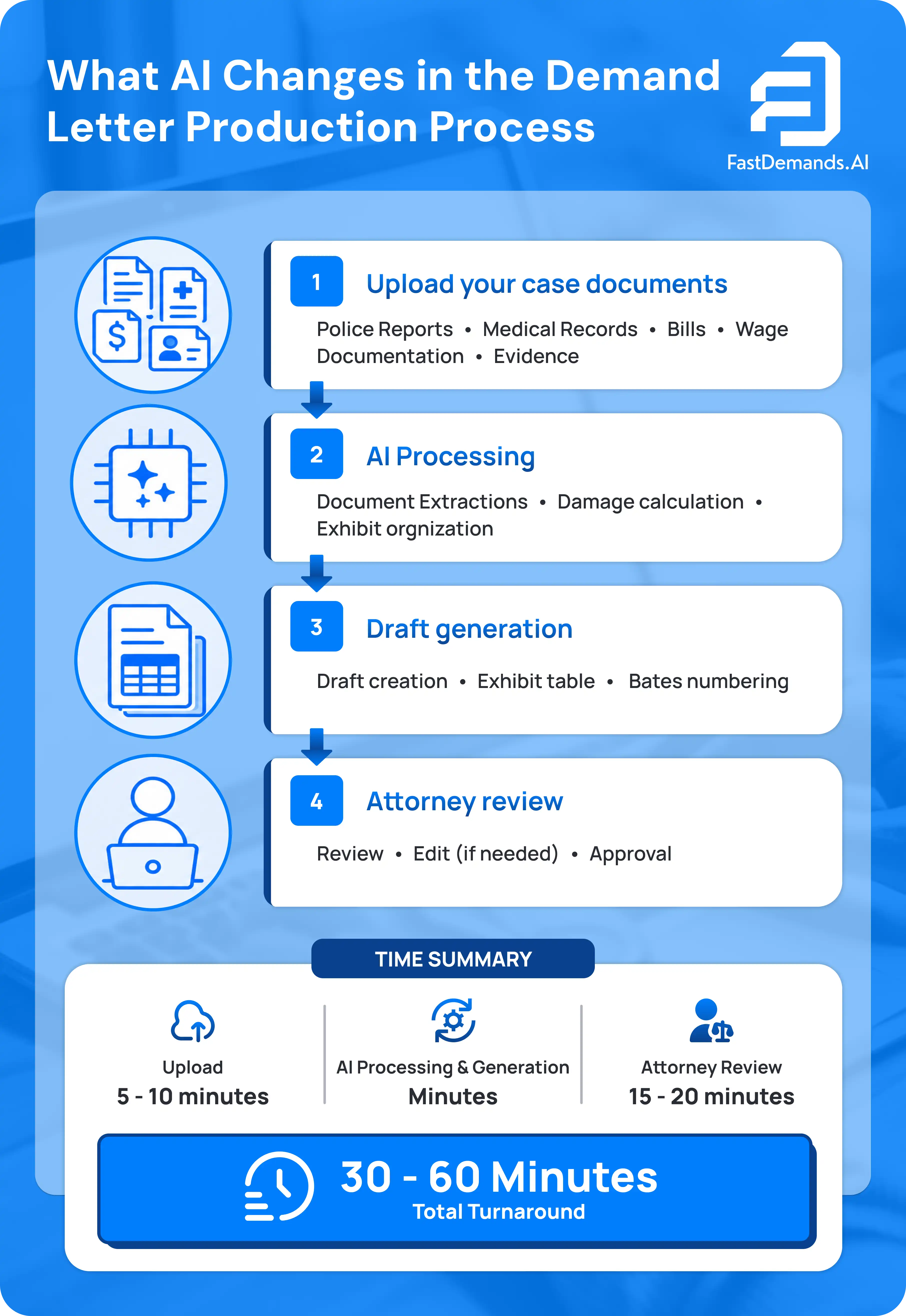
AI demand letter tools change where the production time goes. They do not change the attorney's responsibility for the final output.
Here is what happens when a personal injury demand letter is produced through Fast Demands AI:
Upload
Case files are uploaded police report, medical records, bills, wage documentation, and any supporting evidence. This takes 5 to 10 minutes depending on how documents are organized.
AI processing
Fast Demands AI reads every uploaded document. It extracts the incident narrative from the police report, pulls clinical findings from medical records using the precise terminology in the records, calculates economic damages from bills and wage documentation, and organizes all supporting documents into a numbered exhibit reference list.
Draft generation
A complete, structured demand letter is generated automatically. Every section is populated from the content of the uploaded documents. The exhibit table and Bates-numbered exhibit packet are compiled without manual assembly.
Attorney review
The attorney receives a complete draft and reviews for accuracy, adjusts if needed, and approves. The review step on an AI-generated demand typically takes 15 to 25 minutes because the attorney is reviewing, not drafting.
Total turnaround with AI
30 to 60 minutes from upload to attorney-approved demand.
Demand Letter Turnaround Time: Manual vs. AI
DISCLAIMER: Production time estimates are based on representative figures for moderate personal injury cases. Actual times will vary based on case complexity and documentation volume.
What Affects AI Demand Letter Turnaround Time
AI demand letter turnaround is primarily determined by the quality and completeness of the documents uploaded. Here is what speeds it up and what slows it down.
What speeds up turnaround
Complete medical records uploaded at the case level. When every treating provider's records are included, the AI extracts the full clinical picture without gaps your attorney has to fill in during review.
Organized documentation. Police reports, bills, and wage records uploaded separately and clearly labeled allow the AI to process each file accurately and quickly.
What slows down turnaround
Incomplete medical records. Missing records from treating providers create gaps in the injury narrative that the attorney has to address during review. This extends the review step.
Handwritten or low-resolution documents. Scanned documents with poor image quality slow AI processing and may require the attorney to manually reference the original during review.
Missing damages documentation. Lost wages calculated without supporting employment records, or future medical costs without a treatment plan or physician estimate, require attorney judgment to complete during review.
The more complete the documentation at upload, the closer to 30 minutes the total turnaround time will be.
What Faster Turnaround Actually Means for Your Practice
The production time difference compounds across your monthly caseload.
A firm producing 20 personal injury demands per month at 4 hours each is spending 80 hours per month on demand letter production. At 45 minutes per demand with Fast Demands AI, that drops to 15 hours per month.
That is 65 hours per month recovered from documentation production. Hours that go back to client communication, settlement negotiation, case strategy, and intake.
For firms looking to grow caseload volume without adding staff, faster demand letter turnaround is not a convenience. It is a capacity multiplier.
Demand Letter Response Time vs. Production Turnaround
Two different concepts come up when attorneys research demand letter timing.
Production turnaround is how long it takes your firm to produce the demand letter after the case is ready. AI demand letter tools directly reduce production turnaround.
Demand letter response time is how long the insurer has to respond after the demand is sent. Most demand letters set a 30-day response deadline. There is no universal legal requirement for insurer response time, but most states have bad faith insurance statutes requiring prompt handling of claims.
AI accelerates the production turnaround. The insurer's response timeline is governed by the demand terms and applicable state law. Sending a faster, more complete demand letter does not shorten the response deadline, but it does put the case in the insurer's hands sooner, which moves the resolution timeline forward.
How Fast Demands AI Produces Personal Injury Demand Letters

Fast Demands AI is a purpose-built demand letter platform for personal injury and lemon law plaintiff firms. Every section of the demand letter is generated from your uploaded case files automatically.
What the attorney receives after upload:
- Liability narrative built from the police report and incident documentation
- Injury section built from uploaded medical records using clinical terminology
- Damages summary calculated from bills, wage records, and treatment documentation
- Exhibit table listing every referenced document by number
- Bates-numbered exhibit packet compiled from uploaded files
The attorney reviews, edits if needed, and approves. The production process is complete.
For personal injury firms managing high demand volume, Fast Demands AI changes the production math. More demands per month from the same team. Faster turnaround per case. Consistent output quality across every file.
Start your 7-day free trial and see what the turnaround looks like on your actual cases.
SEE MORE: See how Fast Demands AI builds personal injury demand letters from your case files: Personal Injury Demand Letter Generator
Frequently Asked Questions About Demand Letter Turnaround with AI
See the Turnaround on Your Own Cases
The fastest way to understand demand letter turnaround with AI is to run it on a real case file. Fast Demands AI offers a 7-day free trial with full access to the demand letter generator and every platform feature.
Upload a case you are working on now and see how long the production process actually takes.


