


The demand letter is the document that determines whether a car accident case settles in weeks or drags into months of back-and-forth.
For personal injury firms, knowing how to write a demand letter for a car accident that adjusters cannot easily push back on is one of the most practical production skills on your team. A weak demand invites disputes. A complete, precise demand backed by organized documentation gives the insurer fewer reasons to delay and fewer angles to minimize.
This guide covers every section of a car accident demand letter, provides a real-world example your team can reference, and shows how AI is cutting production time from hours to minutes for firms handling high-volume auto accident caseloads.
KEY TAKEAWAYS
- A car accident demand letter opens settlement negotiations by establishing liability, documenting injuries, and calculating total damages in a single organized package
- Every section of the demand letter must be supported by documentation unsupported figures give adjusters grounds to dispute your claim
- Send after your client reaches maximum medical improvement so the full scope of damages is captured before the demand is submitted
- A 30-day response deadline creates urgency and moves the adjuster toward a timely response
- Fast Demands AI generates complete, structured car accident demand letters from uploaded case files in minutes, ready for attorney review and approval
What Makes a Car Accident Demand Letter Work
A car accident demand letter is a formal written document sent to the at-fault driver's insurer on behalf of your client. It establishes fault, documents injuries, calculates damages, and states a specific settlement figure.
What separates a demand letter that produces a reasonable offer from one that gets lowballed is documentation density. Vague liability arguments give adjusters room to dispute. Unsupported damage figures give them room to counter. A well-organized auto accident demand letter backed by a complete exhibit packet leaves significantly less room for either.
The goal is to present your client's case so completely that the path of least resistance for the insurer is to negotiate seriously rather than delay.
When to Send the Car Accident Demand Letter
Timing determines whether your demand captures the full value of your client's claim or locks in an understated figure the insurer will use to anchor negotiations.
The standard rule is to wait until your client reaches maximum medical improvement (MMI), meaning their treatment has stabilized and the full picture of their injuries and future care needs is documented.
As a practical guide by injury type:
- Minor soft tissue injuries: 30 to 90 days after the accident once treatment concludes
- Moderate injuries requiring physical therapy or specialist care: 3 to 6 months after the incident
- Serious injuries involving surgery, hospitalization, or permanent impairment: 12 months or longer to reach MMI
These ranges are general guidelines; only MMI is determined by the treating physician, not the calendar.
Always confirm the statute of limitations deadline for your jurisdiction before the demand letter is drafted. Most states set a two-year window from the date of the accident, but this varies. Build your case management workflow to flag deadlines before the demand production begins, not after.
How to Write a Demand Letter for a Car Accident: Step by Step
A complete car accident demand letter follows a structured format. Each section builds on the previous one. Here is how to build each one correctly.
Step 1: Gather All Documentation Before You Write
Every claim in your demand letter needs a corresponding document in the exhibit packet. Before writing a single word, collect:
- Police report
- Photos of the scene, vehicle damage, and visible injuries
- Medical records and bills from all treating providers
- Diagnostic imaging reports including X-rays and MRIs
- Physical therapy records
- Employment records and pay stubs documenting lost wages
- Witness statements
- All prior correspondence with the insurer
The documentation you have before you start writing determines the strength of the demand you can produce. See Document Collection Software.
Step 2: Write the Opening and Liability Section
Open by identifying your client, the accident date and location, and the legal basis for the claim. Address the letter directly to the assigned adjuster by name and include the claim number.
The liability section that follows is where you establish fault. Present a clear, evidence-backed account of how the accident occurred and why the at-fault driver bears legal responsibility. Draw directly from the police report, traffic camera footage if available, witness statements, and physical evidence from the scene.
Specific beats are vague every time. "The insured ran a red light as documented in the attached police report, Exhibit 1" carries more weight than "the other driver was at fault."
Step 3: Document the Injuries in Detail
This section translates your client's medical records into a structured, clinical narrative. Cover in sequence:
- The initial emergency room visit and presenting injuries
- All diagnoses using the specific medical terminology from the records
- Every treating provider and the nature of their treatment
- Diagnostic imaging findings
- Physical therapy and rehabilitation records
- Specialist referrals or surgical procedures
- Current condition including any permanent or ongoing symptoms
Use the actual language from the medical records. Clinical precision drawn directly from the records makes the injury narrative harder for the adjuster to recharacterize as minor.
Step 4: Calculate and Itemize All Damages
Break damages into two categories:
Economic damages (calculable):
- All medical expenses past and future
- Lost wages calculated from employment records and pay stubs
- Loss of future earning capacity where applicable
- Property damage to the vehicle
- Out-of-pocket injury-related expenses
Non-economic damages (subjective):
- Pain and suffering
- Emotional distress
- Loss of enjoyment of life
- Loss of consortium where applicable
Every economic figure needs a corresponding document in the exhibit packet. Non-economic damages require judgment, but anchoring them to the documented severity and duration of the injuries strengthens your position and limits the adjuster's ability to dispute the figure.
Step 5: State the Settlement Demand Clearly
After presenting damages, state the total settlement figure directly. Reference that it is supported by the documented losses in the letter. Set a firm 30-day response deadline.
This section should be assertive. The figure reflects your client's documented losses. Present it that way.
Step 6: Organize the Exhibit Packet
Every document referenced in the demand letter goes into a numbered exhibit packet. Create a clean exhibit table listing each document by exhibit number. Bates-number every page for precise cross-reference throughout the letter.
Organization here signals case readiness. Adjusters who receive a complete, well-indexed exhibit packet have fewer grounds to request additional documentation, which shortens the review cycle in your favor.
Car Accident Demand Letter Example
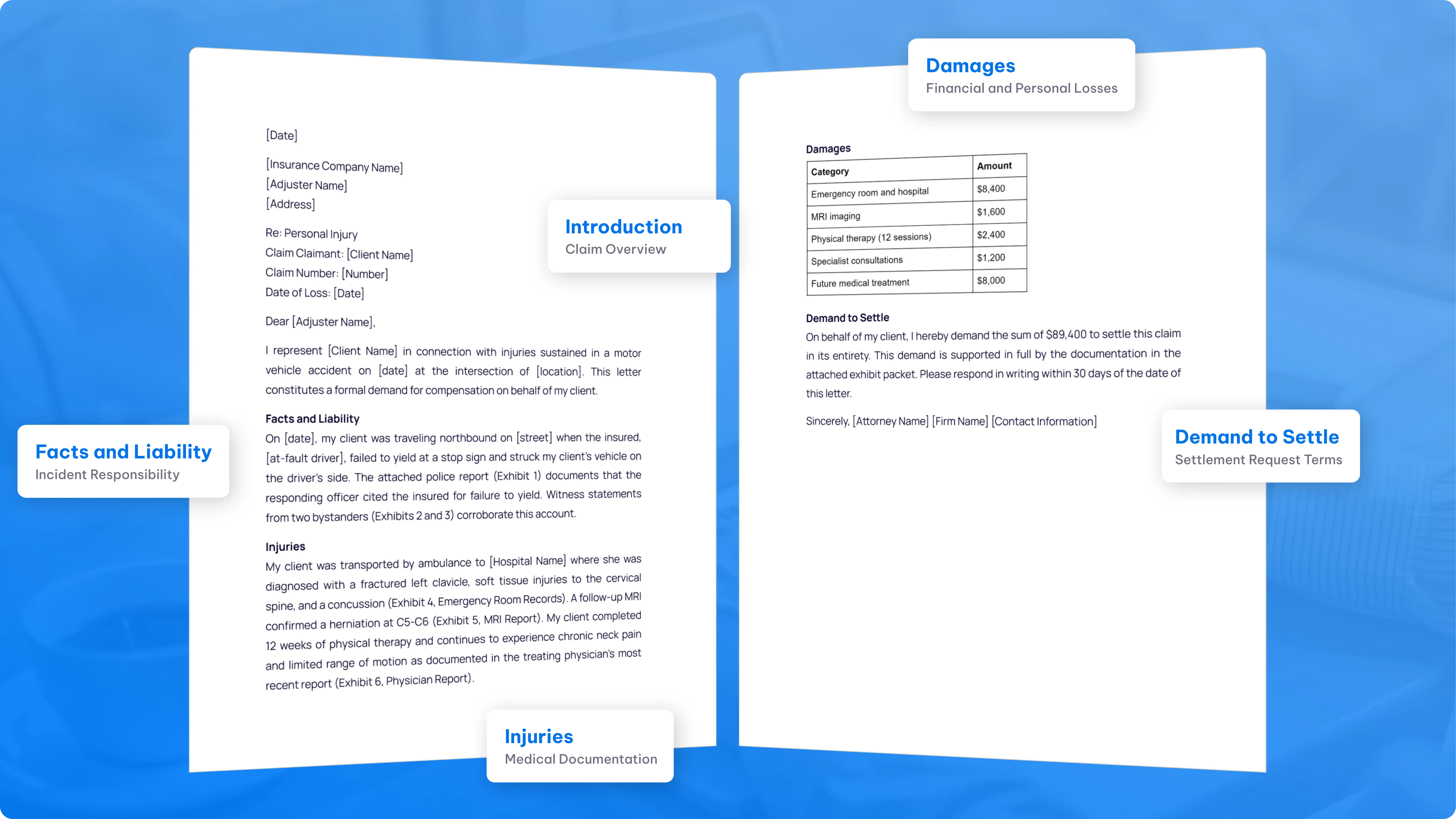
Here is a condensed example of a complete car accident demand letter structure:
[Date]
[Insurance Company Name]
[Adjuster Name]
[Address]
Re: Personal Injury
Claim Claimant: [Client Name]
Claim Number: [Number]
Date of Loss: [Date]
Dear [Adjuster Name],
I represent [Client Name] in connection with injuries sustained in a motor vehicle accident on [date] at the intersection of [location]. This letter constitutes a formal demand for compensation on behalf of my client.
Facts and Liability
On [date], my client was traveling northbound on [street] when the insured, [at-fault driver], failed to yield at a stop sign and struck my client's vehicle on the driver's side. The attached police report (Exhibit 1) documents that the responding officer cited the insured for failure to yield. Witness statements from two bystanders (Exhibits 2 and 3) corroborate this account.
Injuries
My client was transported by ambulance to [Hospital Name] where she was diagnosed with a fractured left clavicle, soft tissue injuries to the cervical spine, and a concussion (Exhibit 4, Emergency Room Records). A follow-up MRI confirmed a herniation at C5-C6 (Exhibit 5, MRI Report). My client completed 12 weeks of physical therapy and continues to experience chronic neck pain and limited range of motion as documented in the treating physician's most recent report (Exhibit 6, Physician Report).
Damages
Demand to Settle
On behalf of my client, I hereby demand the sum of $89,400 to settle this claim in its entirety. This demand is supported in full by the documentation in the attached exhibit packet. Please respond in writing within 30 days of the date of this letter.
Sincerely,
[Attorney Name]
[Firm Name]
[Contact Information]
This example is for illustrative purposes only. Actual settlement values vary by jurisdiction, case facts, and individual circumstances.
Common Mistakes That Weaken a Car Accident Demand Letter

Even experienced practitioners make errors that give the insurer leverage. Here are the most common ones to eliminate from your firm's production process:
Sending before MMI
Sending before treatment is complete almost always understates damages. Adjusters will use missing treatment records to argue the injuries were not serious.
Vague liability arguments
"The driver was negligent" gives the adjuster nothing to evaluate. Reference the police report, cite the specific violation, and attach the documentation.
Unsupported damage figures
Every dollar claimed needs a document behind it. Medical bills without corresponding records, or lost wages without employment verification, give the adjuster grounds to dispute the figure line by line.
Missing future damages
Incurred medical expenses represent only part of your client's losses. Future treatment costs, ongoing pain and suffering, and reduced earning capacity belong in the damages calculation.
No response deadline
A demand letter without a deadline has no urgency. Set a specific date. Thirty days is standard.
Disorganized exhibit packet
An unorganized packet signals that the case is not as thoroughly prepared as it should be. Bates-number everything, provide a clean exhibit table, and make the adjuster's review as frictionless as possible.
How AI Is Changing Demand Letter Production for Personal Injury Firms
Every step in this guide takes time when done manually. For a moderate auto accident case, producing a complete, ready-to-review demand letter can take three to five attorney or paralegal hours before it reaches review. Across a high-volume practice, that compounds quickly.
Fast Demands AI removes that production bottleneck. Upload the case files and the platform reads every document, extracts the key facts, injuries, damages, and evidence, and generates a complete, structured car accident demand letter automatically.
Every section covered in this guide is built from your uploaded documents:
- Liability section drawn from the police report and incident documentation
- Injury narrative organized from uploaded medical records
- Damages structured from bills, wage records, and treatment documentation
- Exhibit table and Bates-numbered exhibit packet compiled automatically
Your attorney reviews, edits, and approves. Production time drops from hours to minutes. Quality stays consistent across every case regardless of volume.
Build Car Accident Demand Letters Faster With Fast Demands AI
Knowing how to write a demand letter for a car accident is the foundation. Having a platform that builds it from your case files is what allows your firm to produce that quality consistently across every case on your docket.
Fast Demands AI generates complete, structured auto accident demand letters from your uploaded documents. Every section covered in this guide is built automatically. Your attorney reviews, edits, and approves before anything leaves the firm.
Start your 7-day free trial and generate your first demand letter today. [Limited Time Offer]


