


A demand letter is the first formal move in any personal injury settlement negotiation. It is the document that tells the insurer your firm has done the work, the damages are documented, and the case is ready.
Most personal injury cases never go to trial. According to the Bureau of Justice Statistics, approximately 96 percent of personal injury cases that reach resolution do so through settlement rather than verdict. The demand letter is where most of those resolutions begin.
For attorneys managing high-volume caseloads, understanding what is a demand letter from an attorney and what separates a strong one from a weak one is the difference between a fast settlement and a prolonged negotiation.
Key Takeaways
- A demand letter from an attorney formally establishes liability, documents injuries, calculates damages, and demands a specific settlement figure from the insurer.
- Every section of the demand letter serves a strategic purpose and must be supported by documentation.
- Demand letters are most effective when sent after the client reaches maximum medical improvement so the full scope of damages is known.
- A well-organized demand letter with a complete exhibit packet reduces back-and-forth with adjusters and accelerates the path to settlement.
- Fast Demands AI generates complete, structured demand letters from uploaded case files in minutes, ready for attorney review and approval.
What Is a Demand Letter from an Attorney?
A demand letter from an attorney is a formal written document sent to the at-fault party or their insurance company on behalf of an injured client. It establishes liability, documents the client's injuries and treatment, calculates total damages, and demands a specific dollar amount to resolve the claim.
From the insurer's perspective, an attorney's demand letter signals that the case is organized and the attorney is prepared. Medical records are attached. Damages are calculated. The liability argument is laid out. That preparation creates real pressure on the adjuster to respond with a reasonable offer rather than delay.
What distinguishes a well-drafted attorney demand letter is precision. Every claim is supported by documentation. Every damage figure is calculated from actual records. Every liability argument is anchored to evidence. The letter is not a narrative. It is a structured case file presented in settlement format.
Why the Demand Letter Drives Most Personal Injury Settlements
Filing a lawsuit is expensive, time-consuming, and unpredictable for both sides. A strong demand letter gives the insurer a complete picture of the case and a clear opportunity to resolve it without litigation.
When your demand letter is thorough, the adjuster has fewer grounds to dispute the damages. When your exhibit packet is organized and Bates-numbered, the adjuster spends less time requesting additional documentation. When your liability argument is airtight, the insurer has less leverage to minimize the offer.
The quality of the demand letter directly influences the speed and amount of the settlement. Firms that produce complete, precise demand letters consistently close cases faster than those relying on informal or incomplete demand packages.
What a Personal Injury Demand Letter Must Include
A personal injury demand letter follows a structured format. Each section builds the case progressively, from establishing liability through calculating total damages and issuing the settlement demand.
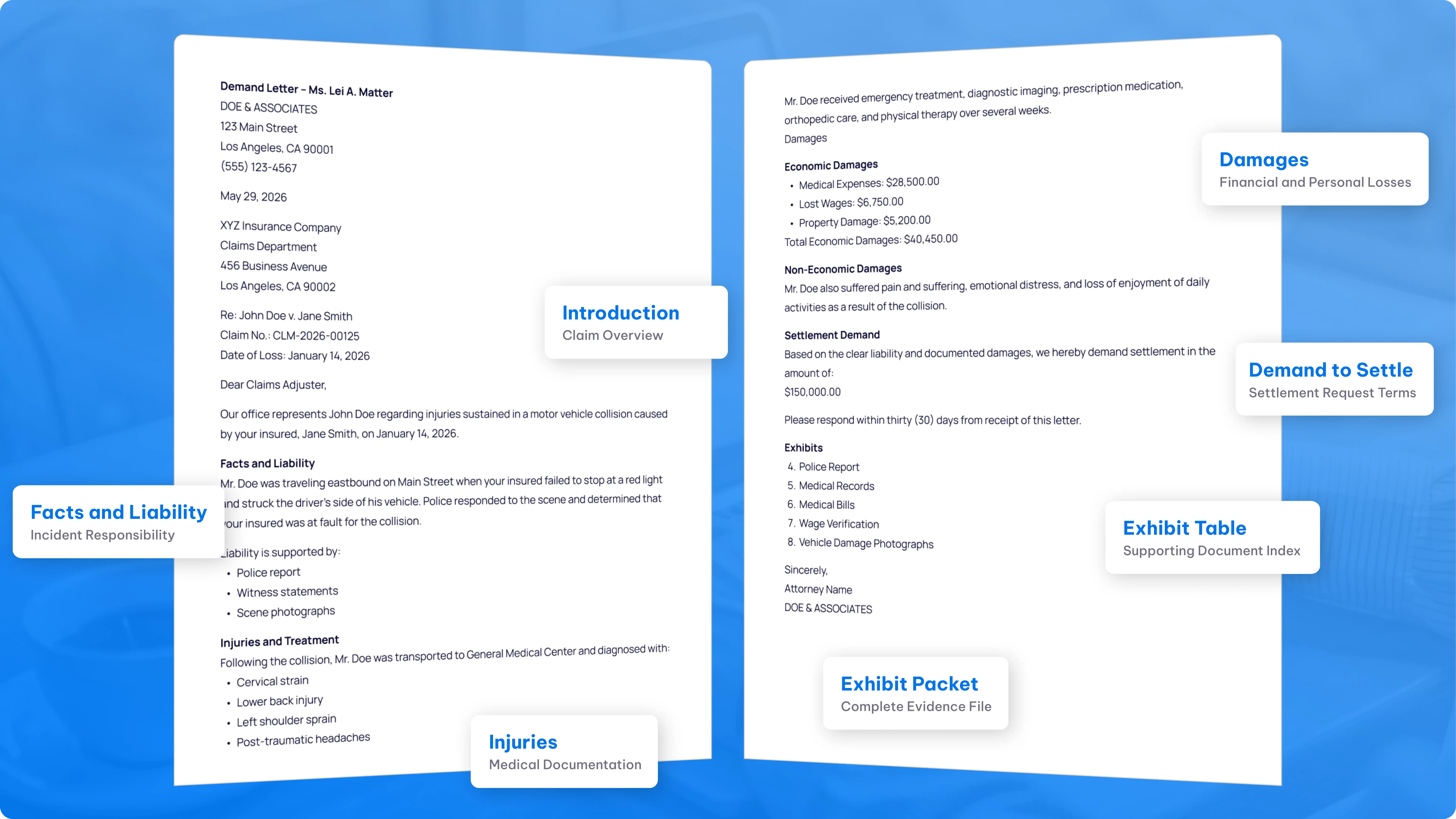
Introduction
The letter opens by identifying the attorney, the client, the date of the incident, and the legal basis for the claim. It addresses the letter directly to the assigned adjuster and establishes a professional, authoritative tone from the first line. This is not boilerplate. The opening frames how the adjuster reads everything that follows.
Facts and Liability
This section presents the incident narrative in a clear, evidence-backed format. It draws from the police report, incident reports, witness statements, and any other documentation that establishes fault. The goal is to build an undeniable account of how the incident occurred and why the at-fault party bears legal responsibility.
Vague liability arguments give adjusters room to push back. Specific, documented accounts backed by attached evidence do not.
Injuries
Every diagnosis, treatment, procedure, and medical finding is documented in structured, clinical language. This section covers the initial diagnosis, all treating providers, specialist referrals, surgical procedures where applicable, physical therapy records, and any permanent or ongoing conditions.
The language here matters. Clinical precision drawn directly from medical records makes the injury narrative harder for the adjuster to minimize. Generalizations invite disputes. Specificity does not.
Damages
Damages are organized into two categories:
Economic damages (calculable):
- Medical expenses past and future
- Lost wages
- Loss of future earning capacity
- Property damage
- Out-of-pocket injury-related expenses
Non-economic damages (subjective):
- Pain and suffering
- Emotional distress
- Loss of enjoyment of life
- Loss of consortium where applicable
Every economic figure is supported by a corresponding document. Medical bills are itemized. Lost wages are calculated from verified employment records. Future medical costs are projected from treatment plans and where necessary, expert assessments.
Demand to Settle
This section states the total settlement demand, anchored to the documented damages in the letter, and sets a firm response deadline. Thirty days is standard. The demand figure should not be arbitrary. It reflects the client's total documented losses adjusted for liability factors and jurisdiction-specific norms.
Exhibit Table
A numbered reference table listing every supporting document in the exhibit packet. This allows the adjuster to locate any exhibit quickly without requesting additional documentation. Organization here signals professionalism and reduces unnecessary back-and-forth.
Exhibit Packet
All supporting documents compiled into a Bates-numbered packet accompanying the demand letter. Medical records, police reports, bills, wage verification, photographs, and any other evidence are sequenced and indexed precisely. A complete, well-organized exhibit packet shortens the adjuster's review cycle and removes a common reason for claim delays.
Personal Injury Demand Letter Example: Auto Accident
Here is how a complete attorney demand letter is structured in a rear-end collision case.
The Facts:
Your client was stopped at a red light when they were rear-ended by a distracted driver. They sustained a cervical herniation at C5-C6, completed 16 sessions of physical therapy over four months, missed six weeks of work, and continue to experience chronic neck pain with limited range of motion.
How the demand letter is built:
The introduction identifies the attorney, the client, and the accident date. It addresses the at-fault driver's insurer directly and references the claim number.
The facts and liability section cites the attached police report, traffic camera footage, and two witness statements establishing that the at-fault driver failed to yield and struck the client's stationary vehicle.
The injuries section documents the emergency room visit, MRI findings confirming the C5-C6 herniation, all 16 physical therapy sessions, and the treating physician's note documenting ongoing chronic pain and restricted range of motion.
The damages section:
[DISCLAIMER: This example is for illustrative purposes only. Actual settlement values vary based on jurisdiction, case facts, and individual circumstances.]
The demand to settle section states the $69,800 figure, references the documented damages, and sets a 30-day response deadline.
When to Send the Demand Letter
Timing determines whether the demand letter captures the full scope of your client's damages or locks in a premature figure the insurer can use to minimize the claim.
The standard rule is to wait until your client reaches maximum medical improvement (MMI), meaning their condition has stabilized and the full scope of medical treatment and future care needs is known. Sending before MMI risks understating damages. Sending too close to the statute of limitations deadline risks leaving no room to litigate if negotiations fail.
Statute of limitations deadlines vary by state and injury type. Always confirm the applicable deadline for your jurisdiction before sending the demand. Your firm's case management process should have a statute tracking system in place before the demand letter is ever drafted.
What Happens After the Demand Letter Is Sent

The demand letter opens the negotiation. Here is how it typically unfolds:
The adjuster receives the letter and begins their internal review. They assess the liability argument, review the medical documentation, and evaluate the damages calculation against their own reserves for the claim.
The insurer responds, typically within the timeframe stated in the letter. Responses include a settlement offer, a counteroffer, a request for additional documentation, or a denial. A settlement offer below your documented damages is not the end of the negotiation. It is the beginning of it.
Your firm evaluates the response. If the offer reflects the documented damages fairly, you advise your client to accept. If it does not, you counter. If the insurer refuses to negotiate in good faith, you file suit.
Most cases resolve before litigation. The quality of the demand letter influences how quickly that resolution happens and at what amount.
How AI Is Changing Demand Letter Production for Personal Injury Firms
Producing a complete, accurate personal injury demand letter manually takes hours. Attorneys and paralegals review hundreds of pages of medical records, calculate damages from multiple sources, format exhibit packets, and write each section from scratch. For firms managing dozens of active cases, that time cost compounds quickly.
Fast Demands AI removes that bottleneck. Upload your case files and the platform reads every document, extracts the key facts, injuries, damages, and evidence, and builds a complete, structured demand letter automatically. Every section covered above is generated from your uploaded documents.
Your attorney reviews, edits, and approves before anything leaves the firm. The drafting time drops from hours to minutes. The quality is consistent across every case. And your team spends more time on negotiation strategy and client communication rather than document assembly.
For personal injury firms handling high caseload volume, that shift is not just an efficiency gain. It is a competitive advantage.
Build Better Demand Letters Faster With Fast Demands AI
Understanding what is a demand letter from an attorney is where the strategy starts. Producing one that is complete, precise, and organized is what drives the settlement.
Fast Demands AI gives personal injury and lemon law attorneys a faster, more consistent way to produce attorney demand letters at scale. Every section of the demand letter covered in this article is generated automatically from your uploaded case files. Your attorney reviews, approves, and sends.
Start your 7-day free trial and generate your first demand letter today.


